
A HANDFUL OF STONES. A FRIEND ACROSS THE BOARD.
Play Mancala
with a friend.
Sow a little. Think ahead. Bring your favorite opponent to a wooden Kalah board and see where the last stone lands.
- One private linkYour chosen opponent
- 48 stonesPlenty of possibilities
- No accountOpen and play
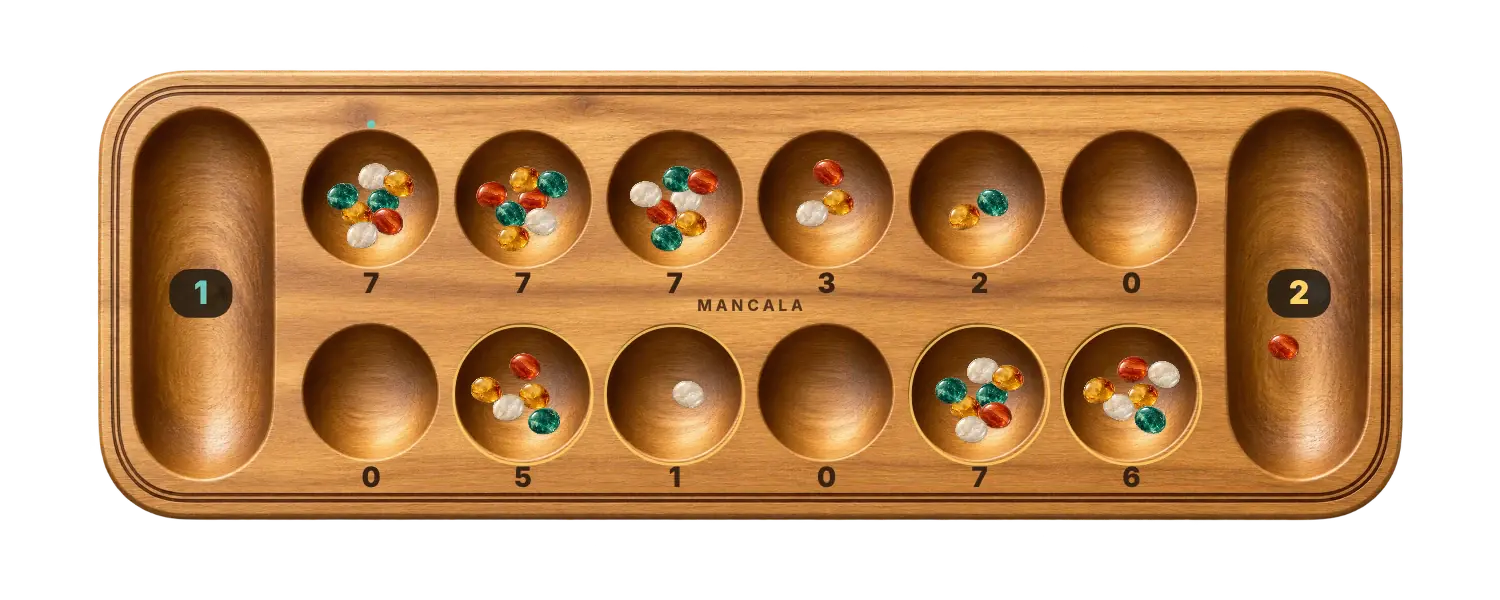
Send a private invitation to your friend.
Collect more stones in your store to win.
Every confirmed move reaches both players.
How to play Mancala with a friend by link
- Create a room. Choose Invite a friend to open a private table.
- Copy your link. Use Share invitation or Play with a friend in the game. Send the invitation to the person you want to play.
- Take your seats. The creator is Gold and the first guest is Teal. Opening your own invitation in the same browser restores your seat.
- Sow the first stones. Once both players are connected, Gold begins. Choose a glowing pit on your side.
You each see your own side nearest you: the lower row on a wide screen or the left column on a tall screen. Your store is at the right or bottom. The board stays in this orientation throughout the round.
For one shared device, see Mancala 2 Player. Practise alone with Vs Computer, or compare all modes in the online guide.
Mancala rules: Kalah with six pits and four stones
Mancala is a family of counting games. This board uses Kalah: six small pits for each player, two larger stores, and four stones in each small pit at the start. The stores begin empty. Gold moves first. Stone colors are decorative; either player can collect any stone.
- Choose one of your nonempty pits. Take all its stones. You cannot choose your opponent’s pits or take stones from either store.
- Sow one stone at a time. Move around the board, dropping a stone into each following pit. Include your own store and skip your opponent’s store. Continue around again if you still have stones.
- Earn an extra move. If your final stone lands in your store, choose another of your pits. You may earn several extra moves in succession.
- Capture across the board. If your final stone lands in an empty pit on your side and the opposite pit contains stones, move your landing stone and all opposite stones into your store. Both pits become empty. If the opposite pit is empty, there is no capture.
- Finish when one side is empty. As soon as either player has no stones in their six pits, the round ends. The other player collects every remaining stone on their side into their own store. This final sweep happens even if the last stone just reached a store.
- Compare your stores. The higher total wins. With 48 stones in all, 24–24 is a draw.
On a shared horizontal board, Gold sows to the right along the lower row and Teal to the left along the upper row. When the board is vertical, Gold sows down the left column and Teal up the right. Online, each player’s view is oriented toward their own side.
This version uses a single sow per move, without relay sowing, a swap rule or capturing from an empty opposite pit. The small number beside each pit shows its exact stone count. Tap or click to play, or use Tab, arrow keys and Enter or Space.
Think about where the last stone will land
Count from a pit to your store before choosing it. Earning an extra move can give you time to prepare a capture or protect a full pit. At the start, Gold’s third pit from the left has just enough stones to reach the store.
Empty pits are opportunities for both players. Check what sits opposite an empty pit before building up a large handful. Sometimes moving a full pit now prevents your friend from collecting it next.
Near the end, count both stores and both rows. Emptying your side gives the remaining opposite row to your friend. A move that ends the round quickly is useful only when the final totals favor you.
Return to your seat and play another round
If a connection drops, the game reconnects and restores the latest confirmed board. Wait for both players to reconnect before continuing. Use the same browser and invitation link to recover your seat; clearing site data removes that browser’s seat information.
Once your friend has joined, both players must agree to New round. A move cancels a pending request. Before the second seat is claimed, the creator can reset the waiting board alone. Colors stay the same and Gold begins every new round.
There is no random matchmaking. Your invitation is for the friend you choose. Local and computer modes have separate browser saves when you want to play between online rounds.
Before the first handful
Which Mancala game is this?
Kalah with six pits on each side and four stones per pit. The rules above describe the exact capture, extra-move and end-of-round behavior used here.
Can I choose my opponent?
Yes. Send your private invitation to your friend. The first guest to open it claims the second seat.
Do the stone colors belong to different players?
No. Gold and Teal identify the player cards and stores. Every stone can be collected by either player, regardless of its color.
Can I capture if the opposite pit is empty?
No. Your landing stone stays in its pit. A capture needs an empty landing pit on your side and at least one stone opposite it.
Why did one player move twice?
A last stone in your own store earns another move, unless a row is empty and the round has ended. Several extra moves can follow each other.
What happens to stones still on the board at the end?
When one row is empty, the other player collects the remaining stones from their own row into their store. The final totals determine the winner.
Your friend. Your table. Your next clever move.
Send an invitation and start counting.
Invite a friend to Mancala ↗