
ONE SCREEN. TWO PLANS.
Nine pieces each. One shared board.
Play Nine Men's Morris together on one device. Set a trap, close a mill and watch a small move change the whole position.
- 9 pieces eachIvory begins
- 24 points16 possible mills
- Three pieces left?Fly to an empty point
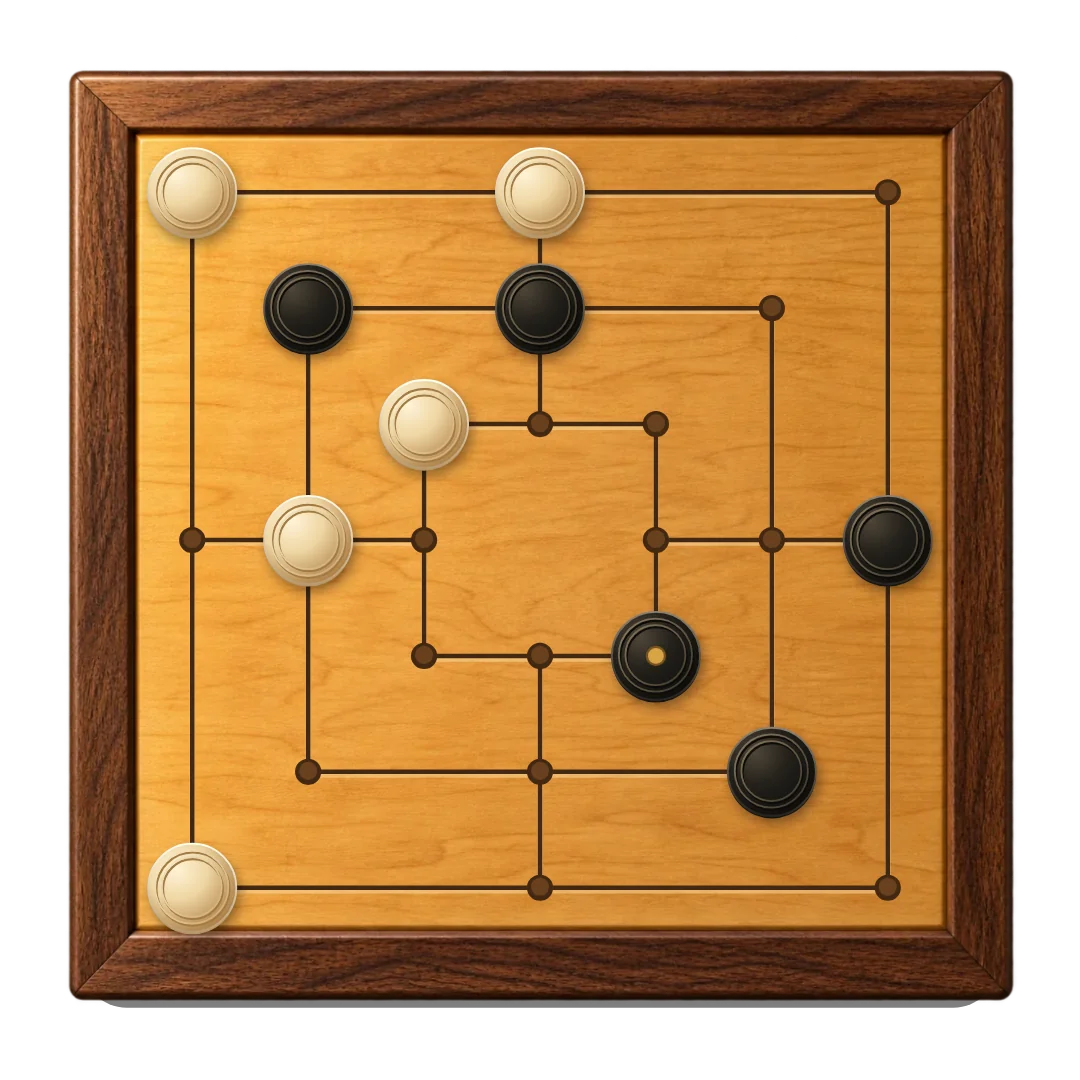
Share a device, invite a friend or play the computer.
Placement, movement and flying follow the same rules.
Browser saves for local play and reconnection for private rooms.
Share a screen and choose your side
Open Same device, choose who plays Ivory and take turns placing pieces. Ivory starts. There is no hidden information: both players can see the complete position throughout the round.
Place nine. Make three. Take one.
Each side starts with nine pieces in reserve. Ivory plays first: Player 1 locally, the room host online, and you against the computer. Take turns placing a piece on an empty point. All eighteen pieces must be placed before movement begins.
Three of your pieces on one connected straight line make a mill. Immediately remove one opposing piece. A piece in a mill is protected while any opposing piece outside a mill remains. If every opposing piece belongs to a mill, any one can be taken. Closing two mills together still gives one capture.
After placement, select one of your pieces and an adjacent empty point along a line. There are no diagonal connections and no line through the center. With exactly three pieces left, you may fly to any empty point. You may open a mill and close it again on a later turn to capture again.
Win by leaving the opponent with fewer than three pieces including reserves, or, after placement, with no legal move. This version draws automatically on the third repetition of a position with the same side to move, or after 100 moves without capture after placement. There is no clock.
Follow the points and the highlighted pieces
Tap or click an empty point to place. Later, select your own piece, then a highlighted destination. When a mill closes, select a highlighted opposing piece to remove it. The highlighted player card shows the active side; reserve counts show how many pieces remain to place. Tab focuses the board; arrow keys select points, Enter or Space activates one, Home finds an available action, and Escape clears selection.
Keep more than one line in play
Leave yourself two ways to complete a mill. Connected middle points create more routes, but an immediate capture can be worth more than a flexible position. Count your opponent’s threats before moving a piece out of a completed mill.
When your opponent reaches three pieces, check every empty point: flying changes which threats matter. For practice, try the computer; for a shared screen, open two-player mode.
Come back to your position
Local and computer rounds save separately in this browser, including an unfinished capture. Switching modes restores the corresponding position. Clearing site data removes local saves and online seat credentials. New round asks before replacing an unfinished local or computer game.
Choose Play with a friend and share the private invitation. The host plays Ivory and the first guest takes Charcoal. Both players must be connected to move. Reopen the invitation in the same browser to recover your seat. Once a guest has joined, both players agree to New round; making a move cancels a pending request.
GOOD TO KNOW
Nine Men's Morris 2 Player FAQ
Can I move before all pieces are placed?
No. Finish the placement phase first. Forming a mill still allows a capture during placement.
Why can I not take a piece from that mill?
Pieces in mills are protected whenever the opponent has a piece outside a mill. If all their pieces are in mills, any one can be removed.
Does a double mill let me take two pieces?
No. This version grants one capture per action, even when the action closes two mills.
Why can a piece jump across the board?
After placement, a side with exactly three pieces can fly to any empty point. With four or more, movement follows one adjacent connection.
Can the round end in a draw?
Yes. Three repetitions of the same position and side to move, or 100 moves without capture after placement, end the round automatically.
There is always another mill to find.
Choose your side and see where nine pieces take you.
Play on one device