
TWO FRIENDS. ONE RIVER.
Play Xiangqi
with a friend.
Meet across a Chinese chessboard. Protect your palace, line up your cannons and give your friend a new position to solve.
- A private invitationYour chosen opponent
- 9 × 10 pointsRed makes the first move
- No clockTake time to think
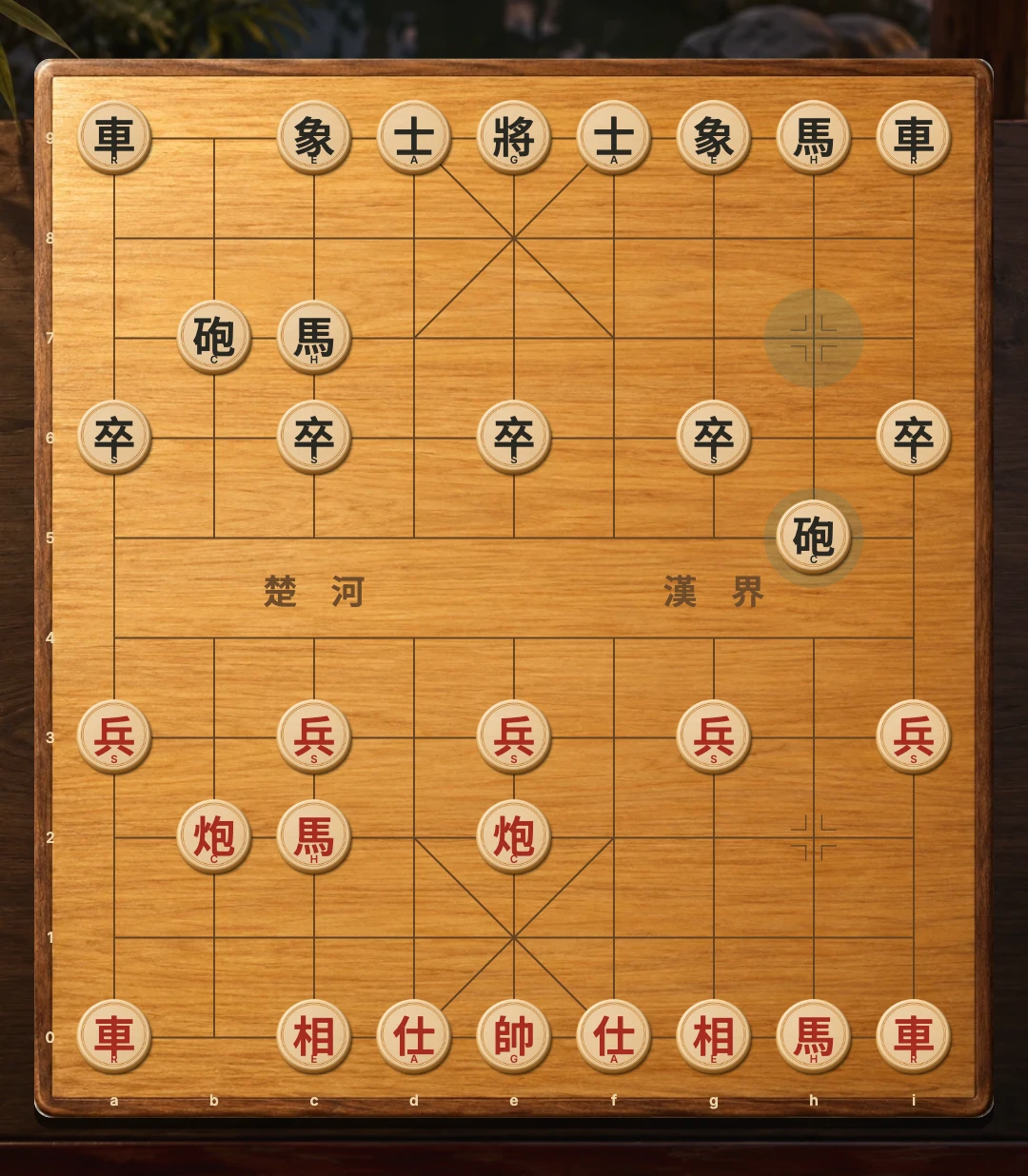
Start a private Xiangqi game
- Create an online board with Invite a friend.
- Open Play with a friend or Share invitation, copy the room link and send it yourself.
- Your friend opens the link in their own browser. The creator is Red; the first guest is Black.
- Stay connected and play. Red starts; select a piece and a highlighted point.
The guest sees Black at the bottom. Game menu → Flip board changes the view. For one screen, choose Xiangqi 2 Player. For practice, try the computer opponent. The online guide compares all modes.
How the Xiangqi pieces move
Red moves first on a grid of nine files and ten ranks. Each side has sixteen pieces, placed on intersections. Select a piece and a highlighted destination. A move must leave your general safe; checkmate or having no legal move loses the game.
The general steps one point horizontally or vertically inside its 3×3 palace. Advisors step one point diagonally inside the palace. The generals must never face each other along a file without a piece between them.
Elephants move exactly two points diagonally and stay on their own side of the river. An occupied midpoint blocks the move. Horses move one point straight, then one diagonally outward; a piece on that first straight point blocks the horse.
Chariots move any clear distance horizontally or vertically. Cannons move the same way without capturing; to capture, a cannon must jump exactly one piece of either color and land on an enemy piece.
Soldiers step one point forward. After crossing the river, they may also step one point sideways. They never move backward and never promote. Captured pieces leave the game.
Letters help identify the discs: G general, A advisor, E elephant, H horse, R chariot, C cannon, S soldier. Hover or focus a point to read its name. Tab focuses a point; Enter or Space selects it. Captured pieces cannot return to the board.
Checkmate, stalemate and repetition
Checkmate wins. A player with no legal move also loses, even without check. The general is never captured.
Casual end rules: the third occurrence of a position with the same player to move is a draw, unless exactly one side gave check on every turn throughout the repeated cycle; that side loses. Tournament perpetual-chase rulings are not applied. A draw also occurs after 60 moves each without a capture or a forward soldier move. There are no clocks or ratings.
Return to your board or play again
The server checks and saves moves before confirming them. If your connection drops, the game reconnects and restores the authoritative position. Both players must be connected to move.
Keep the invitation and use the same browser to recover your seat. Clearing browser storage removes the seat credential. Inactive rooms expire after seven days; opening the same seat in a second tab replaces the earlier connection.
New round needs both players’ agreement. Red starts again. Moves in Game menu shows the history and can copy the starting FEN and ICCS coordinate moves. Local and computer games have separate browser saves.
Before your first Xiangqi game
Is private Xiangqi free?
Yes. No account or payment is required. Create a room and share its link with your friend.
Why cannot my horse reach that point?
A piece may block its first straight step. A move that exposes your general is also excluded.
Why cannot the cannon capture an adjacent piece?
A cannon needs exactly one intervening piece, called a screen, to capture.
Can we play on a phone and a laptop?
Yes. Open the same room invitation in each person’s browser and keep both boards connected.
Can a soldier become a stronger piece?
No. Crossing the river adds sideways moves; reaching the last rank does not promote the soldier.
Invite a friend across the river.
Create a room and make your first move.
Invite a friend to Xiangqi ↗