
THINK IT THROUGH. TAKE YOUR TIME.
Find your next move against the computer.
Practise opening with 30 points, extending runs and spotting new combinations against three computer levels. There is no turn clock.
- 14 tiles each106 tiles in the set
- 30 to openGroups and runs
- No clockTime to think
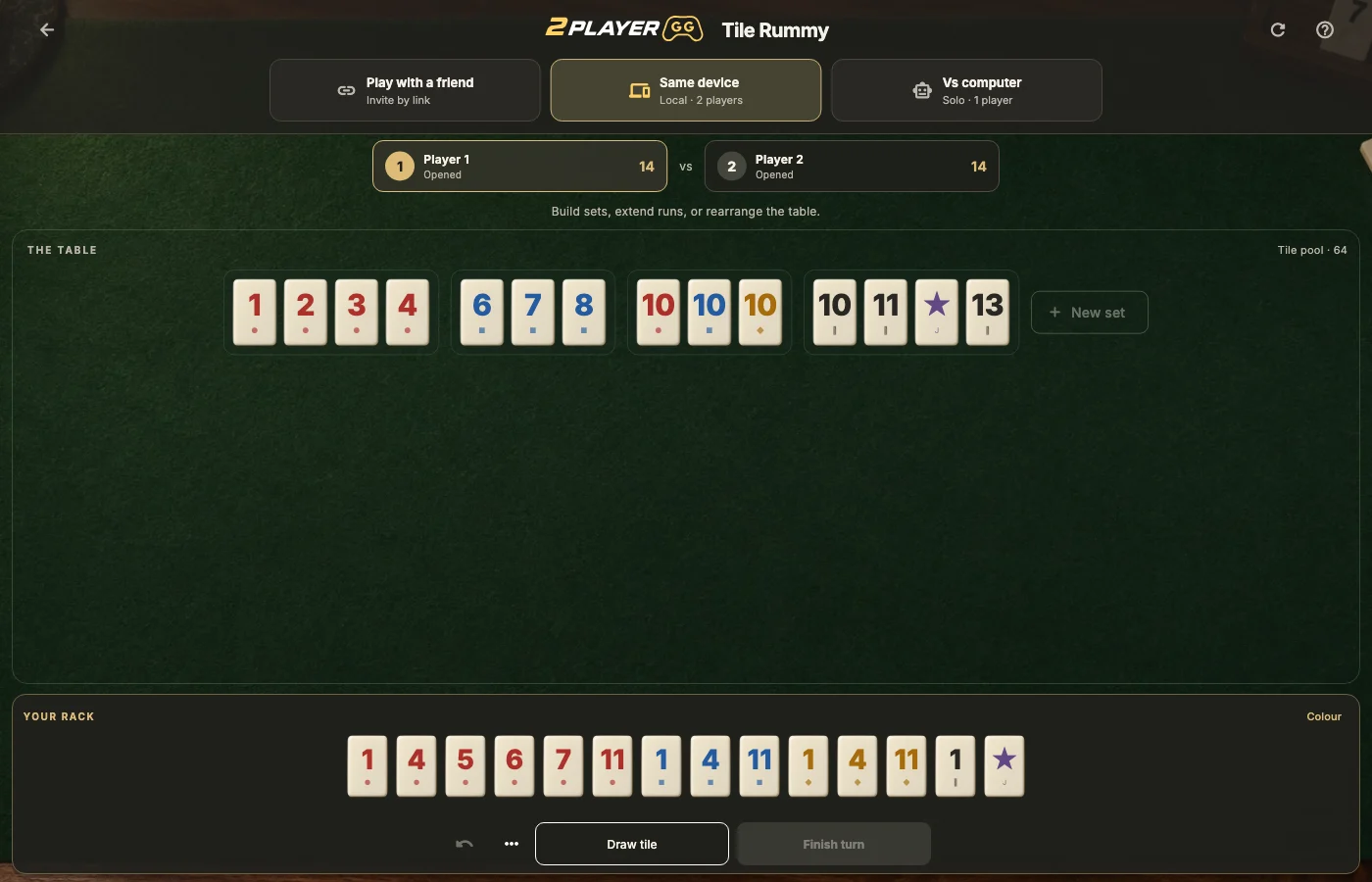
Ivory numbered tiles on green felt.
One device, a private link or the computer.
Edit your table and undo before confirming.
Settle into your game
Choose Vs computer and pick Easy, Medium or Hard in the shared difficulty menu. Easy chooses combinations greedily; Medium explores more alternatives; Hard searches further and can reuse removable table tiles. The computer sees only its rack and the public table.
Groups, runs and a 30-point opening
Two players take 14 tiles each from a shuffled set of 106: two copies of numbers 1–13 in four colours, plus two jokers. Player 1, the online host or the human against the computer, starts the first round. The starter alternates on new rounds.
A group has three or four equal numbers in different colours. A run has at least three consecutive numbers of one colour. There is no 13–1 wraparound. A joker replaces a missing tile; its represented number counts towards an opening.
Your first play must total at least 30 points in new sets made entirely from your rack. Existing table sets cannot contribute or change on that turn. On later turns, extend sets, split runs or rearrange the table. All table tiles, including jokers, must remain in valid sets, and at least one tile must come from your rack.
Drawing one tile ends your turn; you cannot play the drawn tile until a later turn. With an empty pool, pass instead. Two consecutive passes end a blocked round: the lower remaining rack total wins the difference, with equal totals a draw. Emptying your rack wins immediately and scores the opponent’s remaining total. Numbers count at face value, jokers as 30. Each round is independent, without a timer or running match score.
Build a turn before committing
Tap tiles to select them, then New set. To extend a set, select tiles and tap its plus button, or hold and drag a tile onto it. You can move selected table tiles into another set after opening. Undo reverses one edit; Reset table restores the start of the turn. Return to rack only takes back your own unconfirmed tiles. Finish turn confirms a valid table. Reset edits before drawing. Tab and Enter also activate tiles and buttons.
Leave yourself more than one possibility
Keep tiles that fit both a group and a run. Before drawing, look for ways to extend existing sets. A fourth tile in a group or an endpoint in a long run may open a new route. Jokers help you get started, but are worth 30 points if left in your rack.
Try the computer, share one device, or invite a friend.
Return to your table
Local and computer rounds save separately in this browser, including unfinished table edits. Changing difficulty preserves the current round. Online, only confirmed turns are saved: reopen the invitation in the same browser to recover your seat. Both players must be connected to move and agree to a new round. A successful move cancels pending rematch requests. Clearing site data removes local saves and room credentials.
GOOD TO KNOW
Tile Rummy Vs Computer FAQ
Can I use table tiles for my first 30 points?
No. Your opening must use only new sets from your rack. You can change the existing table on later turns.
Can I reuse a joker?
Yes, after opening. Move it into a valid set on the same turn, keep every table tile in valid sets and add at least one tile from your rack. Table tiles cannot return to a rack.
What if my rearrangement does not work?
It stays an unconfirmed edit. Undo one edit or reset the whole table. Finish turn becomes available only when all sets are valid.
What happens when the pool is empty?
Players may pass. Two consecutive passes end the round; the lower rack total wins the difference. Equal totals are a draw.
Are there time limits or a running match score?
No. Play at your own pace. Each new round is independent.